The Rundown: Cabrera Raises Rotation’s Ceiling, Maybe This Kills Hoerner Trade Talk, 3 B’s of Big Bats

Have you seen any of those videos on Instagram, TikTok, or Facebook where they compare two pets at a time, with one clip showing an effortlessly cute or athletic animal and the next showing a total goober? Making it even better is that the first is backed by the sound of Russell Crowe saying, “My name is Maximus Decimus Meridius,” while the second is Channing Tatum from 22 Jump Street awkwardly uttering, “My name is Jeff.” Go check some of them out when you’ve got a second.
No, not now. Okay, fine, but leave this page open so the ad servers think you’re still engaged. See you back in a bit.
Anyway, I know a whole lot of Cubs fans were watching this offseason and seeing Toronto’s Ross Atkins signing the likes of Dylan Cease, Cody Ponce, and Kazuma Okamoto while hearing “My name is Maximus Decimus Meridius” in the background. Meanwhile, the Cubs signed another failed prospect or journeyman reliever and all the fans could hear was “My name is Jed.” That all changed on Wednesday, when Jed Hoyer stepped to the middle of the arena with arms spread wide in defiance.
Are you not entertained?!
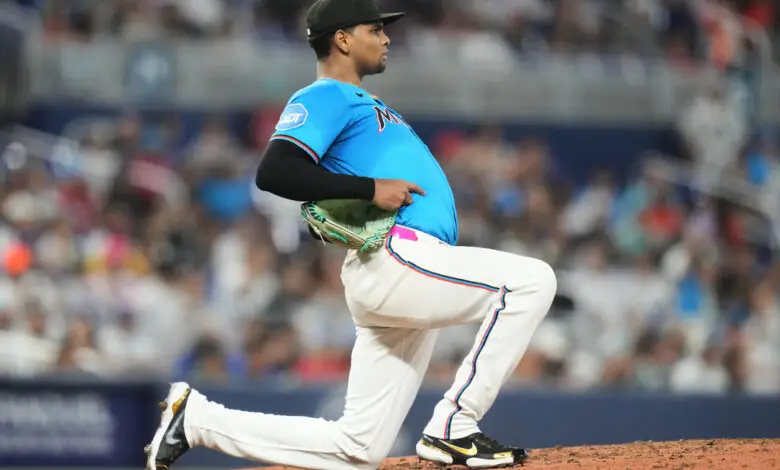
By trading for Edward Cabrera, the Cubs have added a level of dynamism to the rotation that they lacked for years. This is akin to signing reliever Hunter Harvey in that we’re seeing a decided shift in what had been a very risk-averse strategy of pitching staff construction. Cabrera has at least as much risk as upside, what with his 11 trips to the IL and no season with more than 26 starts or 137.2 innings. He has avoided surgery to this point, so at least he’s got that going for him, which is nice.
The Marlins looked like a team motivated to move on from a potential lemon while they still could, and that may be reflected by a return that was lighter than most expected. Caissie was the Cubs’ No. 1 prospect and landed at No. 3 on the Marlins’ rankings, but slugging corner outfielders aren’t exactly hard to find. Not a knock, just a fact. Christian Hernandez was a heralded international free agent with loads of potential, but the 22-year-old is still at High-A and had seven other infielders ahead of him.
Edgardo De Leon is a bit more of a wild card because he’s still a teenager and hasn’t played past the Arizona Complex League, but his youth and long development timeline make him far more expendable. I’d argue that this deal doesn’t sting nearly as badly as the Kyle Tucker trade last winter, especially since the Cubs didn’t have to part with any young pitchers.
Back to Cabrera and how he helps, since I’ve focused on the red flags to this point. His 97 mph fastball and sinker make him far and away the hardest thrower in the rotation, and one of the hardest on the entire staff. Even if he scrapped the heaters altogether, his 94.2 mph average changeup would put him second to Cade Horton in terms of velocity among starters. Cabrera throws his four-seam with more sink and run than most, so it tends to blend with his sinker and could cost him some results.
My initial assumption was that Cabrera is a pronator, but I have learned that he’s actually a supinator with relatively high efficiency. He pitches backwards, throwing his change and curve most frequently and going to the four-seam least often. Because he doesn’t cut the fastball like many pitchers of his ilk, nor does he get enough ride to keep hitters off of it, that pitch hasn’t been very effective. Finding a way to better differentiate it from the sinker, perhaps by getting more cutty with a little less spin efficiency, could be an unlock.
That reduced fastball usage was a new development last season, dropping to under 13% after being over 27% in each of the two previous seasons. With both fastballs generating decidedly negative results last season, it’s pretty clear that something has to change. Maybe I’ll talk with Tyler Zombro about this to see if we can “fix” the big righty.
Hoerner Trade Talks Should Be Dead Now
Nico Hoerner‘s name kept coming up in trade talks, mainly because other teams saw an opportunity to pry him loose in his final year under contract. But with a new starting pitcher now in the fold and a need to maintain a balanced attack on offense to go with premium defense, the Cubs have to keep Hoerner. Even if they don’t extend him again, which they absolutely should, Hoerner is their best all-around player and the type of glue guy you need on a title contender.
If they do somehow manage to sign either of the two right-handed-hitting infielders to whom they’ve been linked, Hoerner can maintain the keystone with Matt Shaw moving to a utility role. As for how to find playing time or what to do next year, that can all be figured out later. If Shaw can develop into a consistent hitter, I prefer him at third base over either Alex Bregman or Bo Bichette.
Killer B’s Still Waiting
I would give Hoyer an A for the Cabrera trade, but he might still be out looking for B’s at this point. In addition to Bregman and Bichette, former Cub Cody Bellinger reportedly remains on their radar. This was already covered in a previous Rundown, so I’ll keep it brief. With the Yankees making Bellinger their top priority and the Red Sox reportedly making an aggressive offer, it’s hard to see the Cubs coming off the top rope to land either. Then you’ve got the Blue Jays atop the Kyle Tucker market, which would push them out on Bichette if they aren’t already after signing Okamoto.
That leaves Bichette, a righty-batting infielder with a .294 career average and enough pop to make him more than just a contact guy. While both his glove and athleticism leave him ill-suited to stick at short, he might be able to handle third. It’s been suggested that he’s willing to move to either his right or left on the diamond, which he’ll really have to do for any team that cares about defense.
Ken Rosenthal believes the Cubs need to be proactive in making a splash for a big bat, and I don’t necessarily disagree. However, I’m not sure they’ve got either the stones or the budget to do so at this point. The calculus changes if Bichette, who missed half of 2024 with calf and finger issues and most of the 2025 postseason due to a sprained knee, has to take a pillow deal. The positional uncertainty is a bigger issue than the injuries, and it could spur Bichette to prove himself.
The other wrinkle here is whether the move to bring in Cabrera on what could be a salary of less than $4 million via arbitration has Tom Ricketts more willing to spend. The Cubs have a little over $31 million left below the first luxury tax penalty, which should be enough to fit Bichette and most of the others, depending on contract structure. Even if they go over, there’s so much falling off the books after 2026 that becoming repeat offenders shouldn’t be an issue.
Not to mention, we don’t even know what the financial structure will look like in 2027 and beyond. The question is whether Ricketts can be convinced to go for it this year when considering all of these factors.
More News and Notes
- Jameson Taillon will join former Cub Owen Caissie on Team Canada’s WBC roster.
- Today is the arbitration filing deadline for teams and players to exchange salary figures, which is big for the Cubs because Cabrera is arb-eligible. You may remember them underbidding Tucker last season before eventually working out a deal.
- Former Reds pitcher Michael Lorenzen, who once toyed with the notion of being a two-way player, has signed with the Rockies.
- Beloved (and sometimes behated) Patrick Wisdom has signed a minor league deal with the Mariners that includes an invitation to spring training. The 34-year-old hit 35 homers for the KBO’s Kia Tigers last season and should still have enough pop to provide a little boost to the bench.
- Staff writers at The Athletic gave the Cubs a B/B+ on the Cabrera deal and gave the Marlins a B+/A-, which is more or less what you want to see.
Sorry there’s no trailer or review today, gotta run.