
Pete Crow-Armstrong’s Increased Bat Speed Could Spur Power Surge

Pete Crow-Armstrong posted the Cubs’ third 30-home, 30-steal campaign ever and first since Sammy Sosa in 1995 (he also did it in ’93), but there was a sense that PCA had a lot more in the tank. His 96th-percentile sprint speed indicates that he could have swiped a few more bags, and his 25 first-half homers were a sign that he could get to 40 or so in that category. Remember, the halves of the season are not equivalent in terms of games or plate appearances.
More telling than a simple extrapolation of his production, however, is the work PCA put in over the winter to increase his bat speed. It’s probably no use explaining this for those who dismissed it immediately upon reading the headline, but bat speed matters. It’s not a panacea for offensive production, nothing is, but swinging the bat fast is the best way to create desirable batted-ball outcomes.
There used to be a notion that you just had to make contact and let the pitch do all the work, so putting the barrel on a Randy Johnson fastball — which was no easy feat in and of itself — would basically get you a homer. But the funny thing about antiquated ideas is that they fall apart like wet toilet paper when exposed to real analysis. Remember, we used to think the sun revolved around the Earth. Hell, Galileo was tried for heresy and forced to live out his life under house arrest for promoting heliocentrism.
The fact of the matter is that pitch velocity’s contribution to exit velocity — the earth is also round, in case you were wondering — has a mere 0.2 coefficient. Bat speed, on the other hand, brings a 1.2 coefficient to the party. That means a 100 mph pitch is responsible for 20 mph of EV, while a 70 mph swing generates 84 mph. If we’re having a potluck, one is tuna noodle casserole and the other is the best mac and cheese you’ve ever tasted.
It should be noted that we’re talking about ideal contact here, as failing to hit the ball flush will obviously not make the most of that coefficient above. That said, having six times more influence on EV is obviously significant. We also know that Ted Williams was right when he said it’s best to hit the ball hard in the air. While duck snorts, infield singles, and seeing-eye grounders are all going to happen, the likelihood of reaching base safely goes up in accordance with EV.
Just so I can make sure we’re on the same page before proceeding, this is not a debatable opinion and there’s no room to disagree. If you balk at the notion that bat speed and exit velocity are important aspects of offensive production — not THE ONLY important aspects, mind you — please let me know so I can remove you from my Christmas card list. Those who accept that the Earth is indeed round and orbiting around the sun may proceed.
Crow-Armstrong’s early bat speed results provide ample optimism for an even bigger season at the plate, or at least that his 2025 numbers weren’t smoke and mirrors. Small though the sample may be, the data shows that only five swings may provide a significant enough platform on which to base projections. As Eno Sarris laid out for The Athletic, the increase in PCA’s top-end bat speed is greater than that of any MLB player with at least 25 swings in each of the last two seasons.
That’s using the median of the fastest 50% of each hitter’s swings in order to account for fluctuation due to situation and pitch type. PCA went from a top-end bat speed of 76.5 mph last September to 78.9 mph in March, which is a little higher than his overall increase from 72.7 mph last year to 73.9 mph so far in 2026. That might not seem like much, nor does an expected EV increase of 1.44 mph, but it results in roughly 80 more points of batting average and about 50 more wOBA points.
As Driveline Baseball ops analyst Sam Ehrlich illustrated, PCA’s increased bat speed could produce a 50-home run season. Even though that was based on some even higher numbers from fewer games and should be viewed with a great deal of caution, it stands to reason that the ceiling has been raised. Perhaps more importantly, the floor should rise as well.

The thing about increased bat speed isn’t just that it will directly correlate to more home runs, but that it broadens a hitter’s margin for error. Every additional tick of EV correlates to around 7 feet of ball flight, which means carrying over a shortstop’s glove or past a leaping outfielder. And in a game decided by fractions of inches or seconds, hitting a ball even slightly harder puts that much pressure on the defense.
That might not even be a matter of him actually hitting the ball hard, as we’ve seen from his bunt hits when the infield plays deeper to respect his power. While much of this still resides firmly in the land of the theoretical, it’s clear that Crow-Armstrong still has room to develop as a hitter in terms of both his average and his power. That possibility bodes quite well for the next seven years.
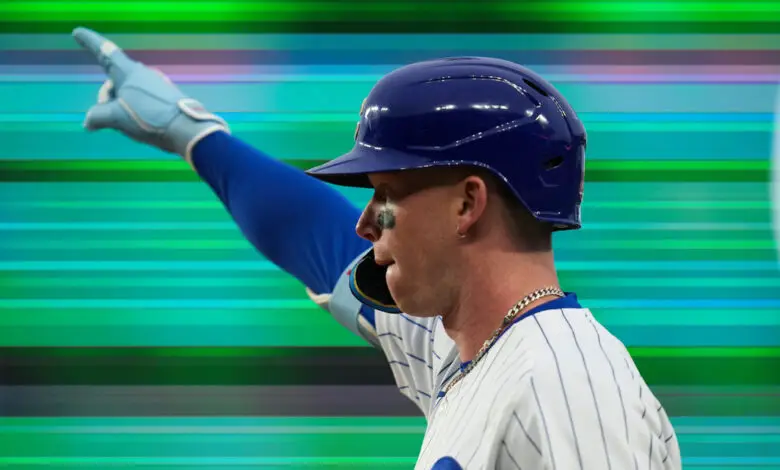
Ed. note: My favorite part about this is that the featured image is from PCA pointing to the dugout after a bunt single.


